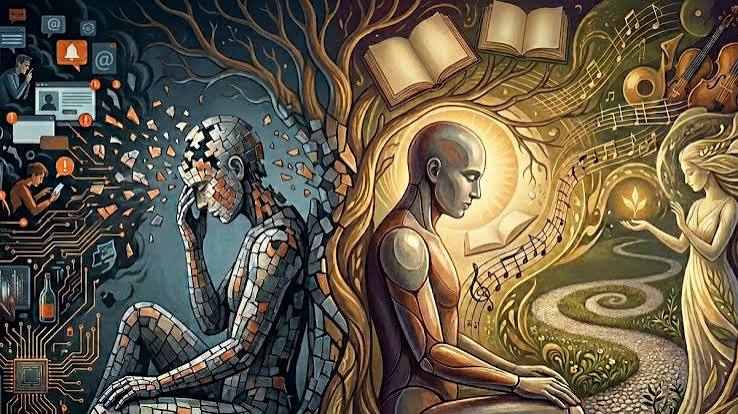
This is where the prevailing story about children and screens, it seems to me, lacks a degree of complexity. In Jonathan Haidt’s The Anxious Generation (2024) and the work that has followed it, a play-based childhood of climbing trees, building forts and suffering the boredom that fuels creativity has been displaced by a smartphone-based one. Because that shift can also mean less sleep, less face-to-face interaction and physical activity, and more social comparison and exposure to online harassment, there is real evidence of harm, including poorer mental health and wellbeing in at least some young people.
But the boredom Haidt mourns is only constructive inside the first map, the emotionally secure childhood. The romantic claim that children left to their own devices will dream, invent and imagine may hold for many children who have been held and experienced healthy emotional attunement. The capacity to turn solitude and boredom into play, in other words, does not arise in a vacuum; it depends in part on a child having enough internal security to tolerate being alone with her own thoughts and feelings.
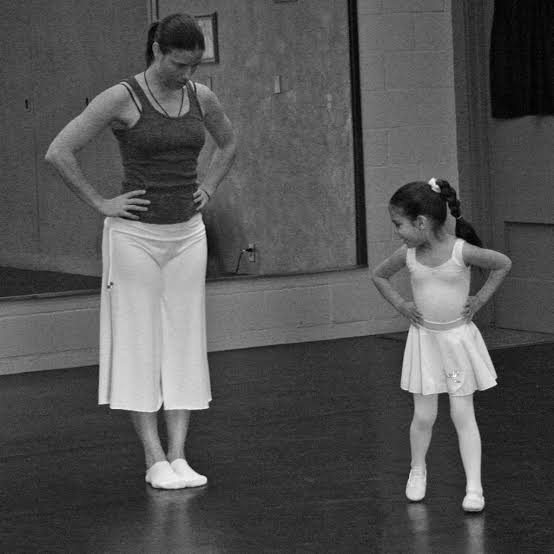
The freedom to play alone itself has a history. A very young child may lose herself in a game because someone she trusts is nearby. With time, she can carry that assurance into an empty room. The British paediatrician and psychoanalyst Donnal wittcon explored this paradox, finding that the capacity to be alone develops through the experience of being safely accompanied.
And once a child can lose herself in play, something remarkable becomes possible. The Soviet psychologist Lev Vygotsky saw imaginative play as a way for children to move beyond the immediate world, trying out unfamiliar roles and exploring possibilities that ordinary life has not yet offered them.
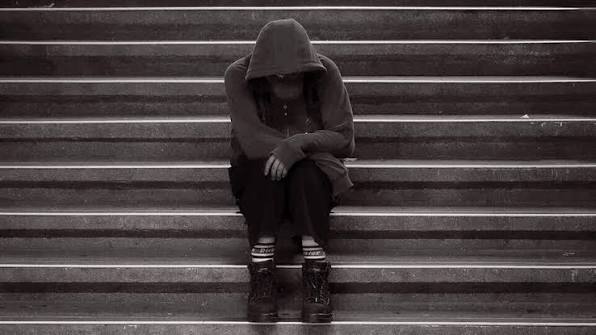
But an empty afternoon holds no such promise for every child. Where one child finds a world to explore, another may find only the anxiety of being left to herself. She may, in time, grow into the adult who sits in my consulting room and laments that she does not know what she likes, because what she liked was, in her early life, never a topic that anyone really asked her about.
She is the child that familiar picture of childhood fails to capture. At home, a parent may be physically present but absorbed in a screen, too distracted to notice her bids for attention. At school, teachers stretched thin may not recognise that she is struggling. In her neighbourhood, the freedom to wander outside and find other children to play with has largely disappeared, replaced by organised activities or time spent alone. She may find some of that lost freedom in online games, where children can still explore, invent and interact with one another without adults directing every move. But this child is looking for something more fundamental than a place to play. She wants someone to notice when she is upset, to ask about her day, to remember what she has said, and to care enough to ask again. The prevailing fear is that AI will displace the human relationships a child needs. But what if those relationships are already painfully inadequate? For this child, the more pressing question may be what AI can offer in their absence – and what it cannot.
This is not a hypothetical future. In 2025, Common Sense Media published a nationally representative survey showing that 72 per cent of teens in the United States have used an AI companion at least once and 52 per cent now use them regularly. One-third have used an AI instead of another human being for a ‘serious conversation’. Behavioral-tracking research published in 2026, which captured actual app usage rather than relying on self-report and thus is likely to be more accurate, showed that more than half of 15- to 17-year-olds used generative-AI-based applications in a seven-month window. Many of these apps were designed for emotional connection. There was even use among children between the ages of four and seven. RAND estimates that 5 million teens in the US, perhaps more, have used an AI app for emotional and mental health support. We have already released AI at scale, without making a conscious decision about how it should be used by those among the most vulnerable in our culture.
As I’ve worked on this piece, I have often thought about my son, who is 11. Like some of his friends, he has started his own experiments with what these systems can offer. He is basically the child Haidt writes about: middle-class, two engaged parents, a school that holds him in mind, and a play-based childhood that was preserved but, alas, only imperfectly. What I notice when I watch him with AI is not what the most prominent discourse would seem to predict. He is clearly not being colonized or deadened. But I do notice that he is being relieved of something: the subtle friction of having to wait for the answer that comes late or not at all.